
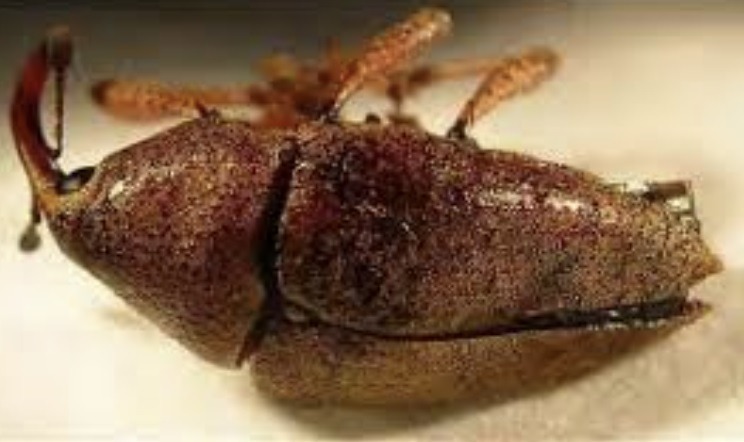
THE PINEAPPLE WEEVIL
DESCRIPTION: The eggs are oval, dull, white, and semi-transparent. The larvae are white except the head, which is light brown in colour; legless and grows to a size of 2.5 cm. The adult pineapple weevil is uniform black in colour, without scales or hairs. The length excluding the snout is 19.5-20.5 mm and 7.7-7.5 mm wide. The prothorax and the venter are very shiny. The elytra are broadest at the shoulders and gradually get narrow behind. The coxae have a small tuft of reddish hairs.
DAMAGE SYMPTOMS: In the 1956/57 survey it was reported that the larvae of the pest tunnelled into the fruit –stalk and/or fruit, weakening the stalk and creating a gelatinous ooze at the point of entry or injury at the point of entry of the fruit (Figures 2 & 3). Severely infested fields showed yellowing of the plants. Advanced stalk infestations resulted in breaking of the stalk and falling over of the fruit, as the stalk was unable to bear the weight of the fruit. The fruit was then considered unfit for human consumption.
BIOLOGY AND ECOLOGY: Gowdey (A Government Entomologist) studied the lifecycle of M. ritchiei in 1922. The lifecycle is completed in 12 – 15 weeks (3 – 4 months). The eggs are oviposited singly in shallow excavations made usually in the fruit stalk at the junction of the stalk and fruit of the pineapple. The larvae hatch in eight to ten days and tunnel upward in the rootstock or fruit stalk or in the fruit itself. The larval stage lasts 8 – 10 weeks. The pupa is formed at the extremity of the tunnel lasting 18 – 24 days. The adults are poor fliers and require a great deal of protection from the direct rays of the sun. It prefers a very humid environment as it shows a preference for the recesses of dense vegetation.
In the 1956/57 survey it was observed that infestation was generally found in fields where cultural practices were poor and where the plants were covered with weeds, bush or heavily shaded by overhanging trees. No infestation was found on newly established pineapple plants even when adjoined to heavily infested beds. The pest showed a distinct preference for fields, which were left to produce a ratoon crop and the greater number of times the field had been ratooned, increased the likelihood of it being infested.
INTEGRATED PEST MANAGEMENT STRATEGIES